
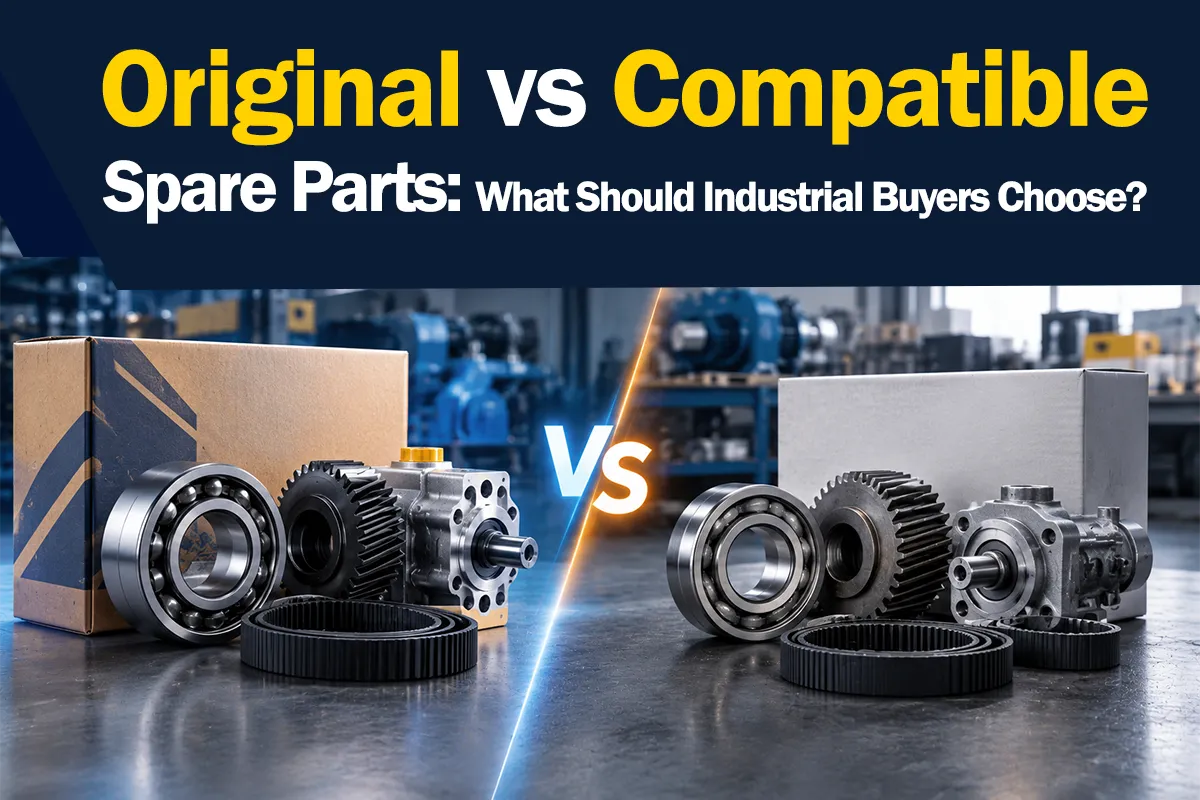
Original vs. Compatible Spare Parts: What Should Industrial Buyers Choose?
Choosing between original and compatible industrial spare parts is an important decision for maintenance managers, procurement teams, and factory operators. The right choice can affect equipment reliability, maintenance costs, production continuity, and the long-term performance of industrial machinery.
Original parts are supplied by the equipment manufacturer or its authorized parts network, while compatible parts are manufactured by other suppliers to fit or function with specific equipment. Both options can be suitable, but the best choice depends on the component, application, operating conditions, and quality requirements.
What Are Original Industrial Spare Parts?
Original spare parts are components supplied by the original equipment manufacturer (OEM) or through its authorized distribution network. They are designed for the relevant equipment and are generally identified by manufacturer part numbers and technical specifications.
One of the main advantages of original parts is that they provide a clear reference for compatibility with the intended machine. This can be particularly important for complex automation systems, specialized machinery, and components that directly affect equipment safety or performance.
However, original parts may have higher purchase prices or longer lead times, depending on the manufacturer, product availability, and delivery location.
What Are Compatible Industrial Spare Parts?
Compatible spare parts are manufactured by a company other than the original equipment manufacturer and are designed to fit or perform a particular function in existing equipment.
A compatible part may offer a cost-effective alternative when the original component is expensive, unavailable, or difficult to source. Some compatible parts are manufactured to demanding quality standards, but their quality, durability, and technical performance can vary between suppliers.
Compatibility should never be assumed based on appearance or dimensions alone. Buyers need to verify the component’s electrical ratings, mechanical specifications, operating limits, and suitability for the intended application.
Original vs. Compatible Spare Parts: Key Differences
| Factor | Original Spare Parts | Compatible Spare Parts |
|---|---|---|
| Manufacturer | Original equipment manufacturer or authorized supply network | Third-party manufacturer |
| Compatibility | Designed for the specified equipment | Must be verified against equipment requirements |
| Purchase cost | May be higher | May offer a lower initial cost |
| Availability | Depends on OEM stock and distribution | May provide additional sourcing options |
| Quality consistency | Supported by the OEM’s specifications and quality controls | Depends on the manufacturer and product |
| Warranty | Subject to the manufacturer’s terms | Depends on the supplier’s terms |
| Technical support | May be available through the OEM network | Depends on the supplier |
| Best use case | Critical or highly specialized applications | Verified alternatives where specifications and quality are suitable |
When Should Industrial Buyers Choose Original Parts?
Original spare parts are often the preferred option when equipment operates under demanding conditions or when component failure could create significant safety, quality, or production risks.
They may be particularly appropriate for:
- Safety-related components and critical control systems
- Specialized machine components with limited alternatives
- Equipment covered by manufacturer warranty requirements
- Applications requiring specific OEM approvals
- Components where precise performance is essential
For example, replacing a critical automation module with an unverified alternative may introduce communication problems, unexpected machine behavior, or compatibility issues. In these situations, using the specified original part can reduce uncertainty.
Nevertheless, buyers should still verify the part number, revision, and equipment compatibility before ordering.
Read More: How to Choose the Right Industrial Sensor for Your Machine
When Are Compatible Parts a Good Choice?
Compatible parts can be a practical option when a suitable alternative has been technically verified and meets the machine’s operating requirements.
They may be worth considering when:
- The original part is discontinued or difficult to source.
- The OEM lead time is too long for maintenance requirements.
- A verified alternative offers a lower total cost.
- The component is a standard industrial item available from reputable manufacturers.
- The supplier can provide technical specifications and appropriate quality documentation.
For instance, a compatible industrial sensor may be suitable if its output type, supply voltage, sensing range, connection, mounting dimensions, and environmental ratings match the application.
The important factor is not simply whether a part is compatible in theory, but whether it performs reliably under the actual operating conditions.
How to Compare the Total Cost of Spare Parts
The purchase price alone does not determine which spare part offers better value. Industrial buyers should consider the total cost associated with acquiring, installing, operating, and potentially replacing a component.
A lower-priced part may become more expensive if it fails frequently or causes extended downtime. Conversely, an appropriately selected compatible part can reduce procurement costs without compromising performance.
Read More: How to Reduce Maintenance Costs Without Sacrificing Reliability
When comparing alternatives, consider:
- Purchase price: Compare the initial cost of each option, including shipping and any additional procurement expenses.
- Expected service life: Evaluate available reliability data, manufacturer specifications, and the supplier’s track record.
- Installation and testing: Consider whether the alternative requires additional engineering work, configuration, or machine testing.
- Downtime risk: Estimate the production impact if the part fails or does not function correctly.
- Warranty and support: Review the warranty conditions, return policy, technical assistance, and availability of replacements.
- Lead time: Determine how quickly each option can be delivered and installed.
A complete cost comparison helps procurement teams make decisions based on operational value rather than price alone.
How to Verify a Compatible Spare Part Before Buying
Before purchasing a compatible component, maintenance and procurement teams should follow a structured verification process.
First, identify the original part number and the exact equipment model. Then compare the technical specifications of the proposed replacement with the original component’s requirements.
For electrical and automation parts, check supply voltage, current ratings, output signals, communication protocols, firmware or configuration requirements, and connection types where applicable.
For mechanical and hydraulic components, verify dimensions, pressure ratings, material compatibility, load capacity, operating temperature, and other relevant specifications.
Finally, request technical documentation from the supplier and confirm that the component is suitable for the intended application. Critical parts should undergo appropriate testing and validation before being returned to production.
Common Mistakes Industrial Buyers Should Avoid
Several purchasing mistakes can increase the risk of equipment failure.
Choosing a part based only on its price may overlook differences in quality, service life, or operating capability. Assuming that two components are interchangeable because they look similar can also lead to installation or performance problems.
Another common mistake is failing to check revision numbers, software compatibility, or communication requirements when replacing automation components. Even a part with a matching model family may require additional verification.
Buyers should also avoid suppliers that cannot provide clear product identification, relevant specifications, or reasonable after-sales support.
Read Also: Industrial Spare Parts Buying Guide for Maintenance Managers
How SAEN Helps Industrial Buyers Source Spare Parts
Finding the right industrial spare part requires a balance between compatibility, availability, quality, and cost. SAEN supports industrial customers by supplying automation, electrical, hydraulic, mechanical, and pneumatic spare parts for manufacturing applications.
Whether you need an original component or are evaluating a compatible alternative, providing the equipment model, original part number, photographs, and technical specifications can help clarify your requirements. Contact SAEN to discuss your spare parts needs and identify suitable sourcing options for your machinery.
Conclusion
Original and compatible industrial spare parts can both play a role in effective maintenance and procurement strategies. Original parts offer a clear route to equipment-specific compatibility, while verified compatible alternatives may provide additional flexibility in cost and availability.
The best decision depends on the component’s criticality, technical requirements, supplier reliability, lead time, and total cost of ownership. By verifying specifications and evaluating operational risks before purchasing, industrial buyers can make more informed decisions and maintain reliable production.
Leave a Reply
No comments have been sent yet!