
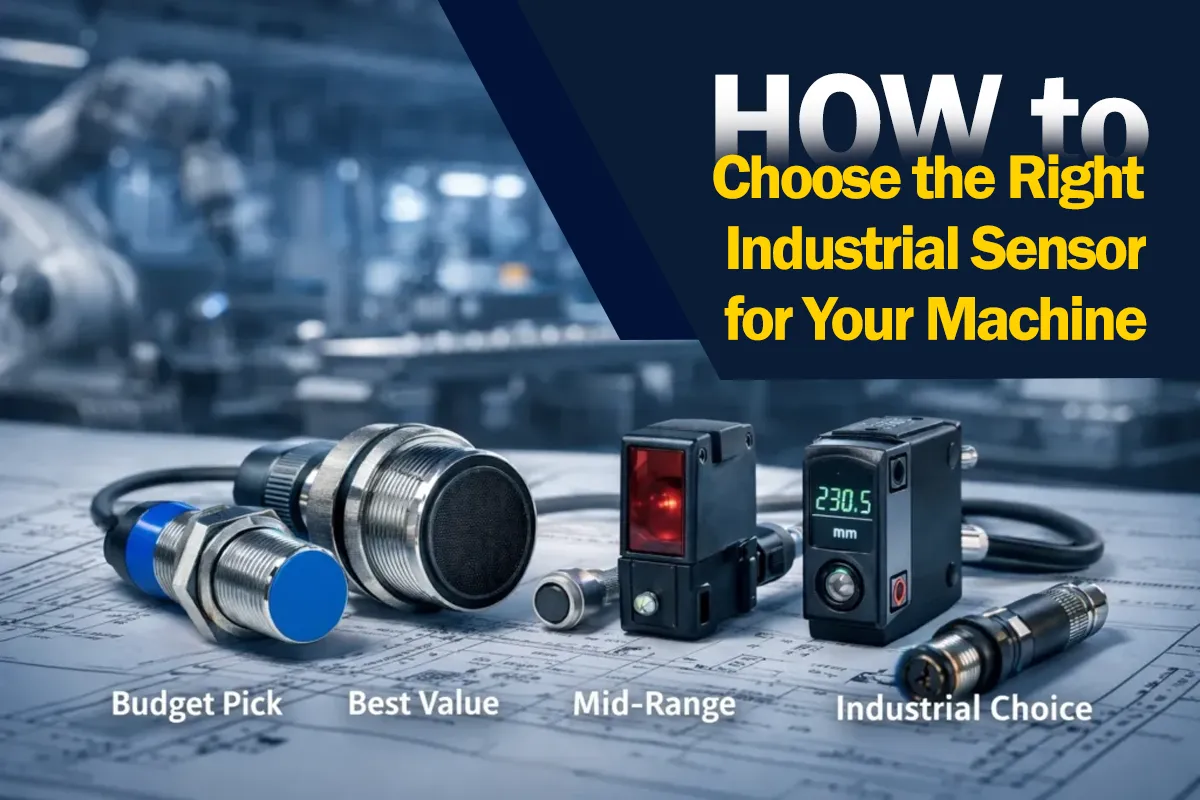
How to Choose the Right Industrial Sensor for Your Machine
Industrial sensors provide machines and automation systems with essential information about position, temperature, pressure, speed, level, proximity, and other operating conditions. Choosing the wrong sensor can result in inaccurate measurements, false signals, production errors, and unexpected downtime. The right selection depends on the machine, application, environment, and required measurement.
1. Identify What You Need to Measure
The first step is to determine exactly what the sensor needs to detect or measure. Different applications require different sensor technologies.
Common industrial measurements include:
- Position and proximity
- Temperature
- Pressure
- Speed and rotation
- Flow
- Level
- Vibration
- Distance
For example, a proximity sensor may be suitable for detecting the presence of a component, while an encoder is more appropriate when precise rotational position or speed feedback is required.
2. Choose the Appropriate Sensor Type
Once the measurement is defined, select a sensor type that matches the application.
Proximity sensors are commonly used to detect objects without physical contact. Inductive sensors are particularly useful for detecting metal components, while photoelectric sensors can detect a wider range of objects.
Temperature sensors such as thermocouples are used in applications where monitoring process or equipment temperature is essential.
Pressure sensors measure hydraulic, pneumatic, or process pressure and are frequently used in industrial machinery. Encoders provide feedback about rotational position, speed, or movement and are important in automated motion-control applications.
The sensor technology should be selected based on the required measurement rather than simply replacing an existing component with a similar-looking model.
Read More: How to Choose the Right Hydraulic Motor for Your Application
3. Check the Operating Environment
Industrial environments can expose sensors to dust, moisture, vibration, heat, chemicals, and mechanical impact. These conditions can significantly affect sensor performance and service life.
Before selecting a sensor, consider:
- Operating temperature
- Moisture and humidity
- Dust and contamination
- Chemical exposure
- Vibration and shock
- Outdoor or indoor installation
- Physical space available
For demanding environments, the sensor should have appropriate protection and construction for the conditions in which it will operate.
4. Verify Measurement Range and Accuracy
Every sensor has a specific measurement range and level of accuracy. The selected sensor should cover the machine’s normal operating conditions without being pushed continuously to its limits.
For example, a temperature sensor designed for a lower temperature range may not be suitable for a high-temperature industrial process. Similarly, an application requiring precise positioning may need a higher-resolution encoder than a simple speed-monitoring application.
5. Check Output and Communication Requirements
Sensor output must be compatible with the machine’s PLC, controller, drive, or other automation equipment.
Depending on the application, sensors may provide different types of outputs, including switching signals, analog signals, or digital communication. Voltage, current, connection type, and communication protocol should all be verified before purchasing a replacement.
A sensor with the correct physical specifications but an incompatible output may not work correctly with the existing control system.
6. Consider Installation and Physical Dimensions
The available installation space is another important consideration. Check the sensor’s dimensions, mounting method, connection type, cable length, and sensing distance.
In some machines, there may be limited space around moving components or difficult-to-access mounting points. Choosing a sensor that fits the existing installation can simplify replacement and reduce modification requirements.
7. Consider Response Time
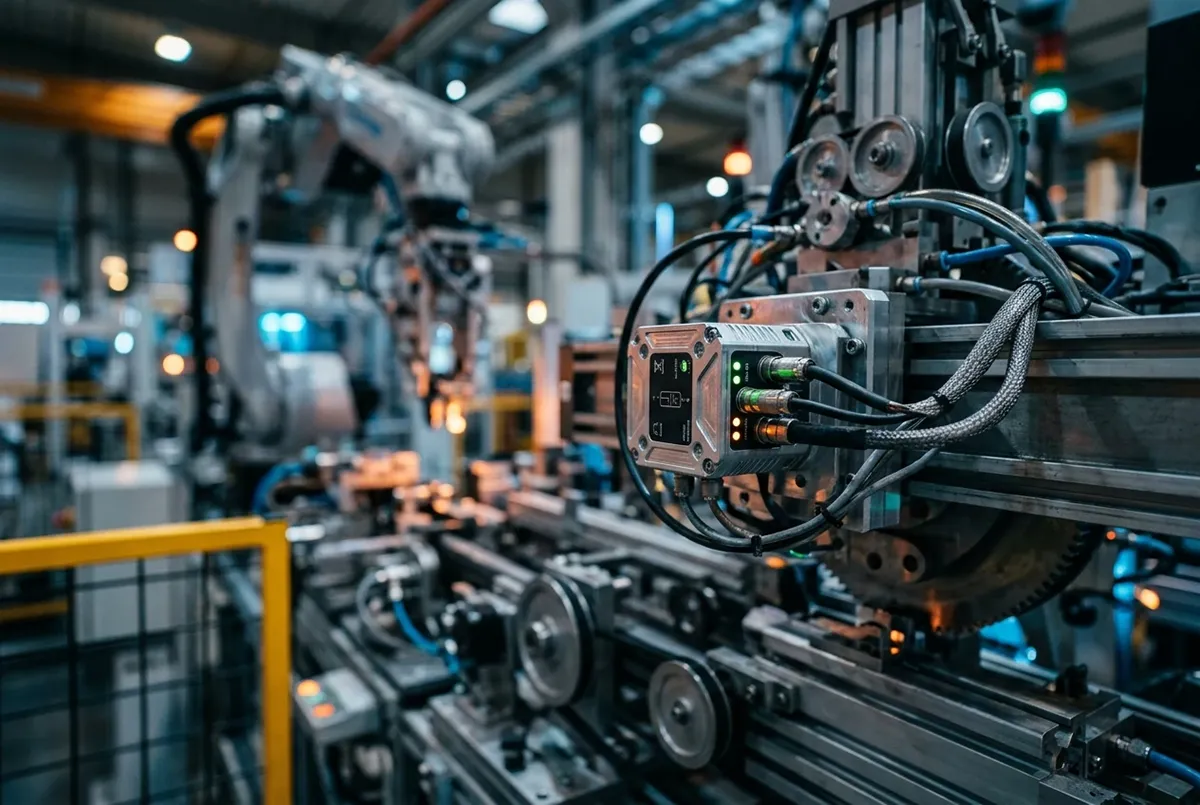
Some automated machines require sensors to detect changes extremely quickly. In high-speed production lines, packaging equipment, conveyors, and motion-control applications, sensor response time can directly affect machine timing.
The selected sensor should therefore provide a response speed appropriate for the machine’s operating cycle.
8. Check Compatibility With Existing Equipment
Compatibility is one of the most important factors when replacing an industrial sensor. Before ordering, compare the existing sensor’s:
- Part number
- Manufacturer
- Supply voltage
- Output type
- Sensing range
- Connection
- Dimensions
- Mounting configuration
- Environmental specifications
If the original sensor is no longer available, these specifications can help maintenance teams identify a suitable alternative.
9. Consider Sensor Reliability and Service Life
The lowest purchase price does not necessarily represent the lowest overall cost. A sensor that fails frequently can create repeated maintenance work and production interruptions.
For critical machinery, consider the sensor’s expected service life, construction quality, operating conditions, manufacturer support, and availability of replacement units.
Keeping critical sensor models in the spare parts inventory can also reduce downtime when failures occur.
Read More: How to Reduce Maintenance Costs Without Sacrificing Reliability
Choosing Sensors for Critical Machinery
For machines where a sensor failure can stop an entire production line, selection should receive additional attention. Maintenance teams should identify which sensors are critical to production and document their specifications.
A spare sensor should ideally be available for critical applications, particularly when the component has a long procurement lead time or is difficult to source.
Conclusion
Choosing the right industrial sensor requires more than matching the appearance or part number of an existing component. Measurement type, sensor technology, operating environment, accuracy, range, output, installation requirements, response time, compatibility, and reliability should all be considered. Proper sensor selection helps maintain accurate machine control, reduce false alarms, prevent production problems, and improve equipment reliability.
Find the Right Industrial Sensors with SAEN
SAEN supplies industrial automation and electrical components for manufacturing and industrial applications. If you need proximity sensors, temperature sensors, pressure sensors, encoders, or other automation components, contact SAEN to discuss your machine requirements and identify a suitable solution for your application.
Leave a Reply
No comments have been sent yet!