
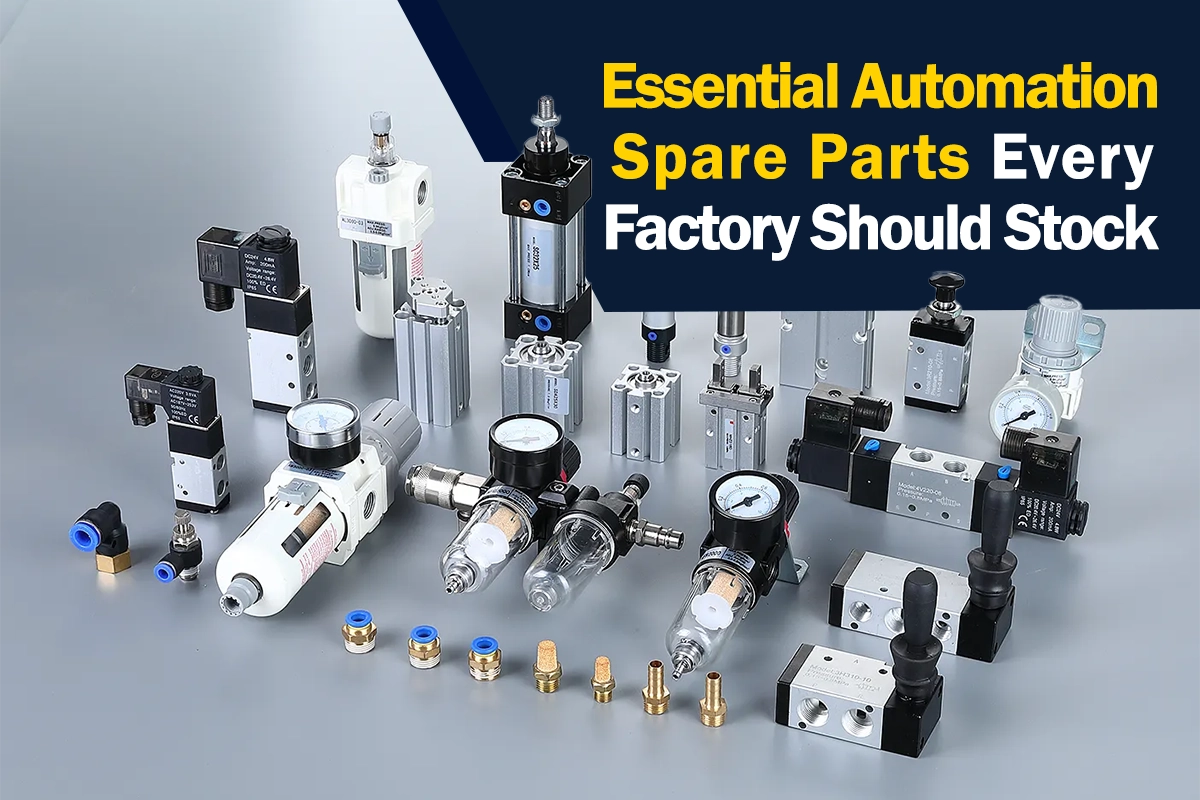
Essential Automation Spare Parts Every Factory Should Stock
Automation systems are central to modern manufacturing, controlling equipment, monitoring processes, and maintaining consistent production. When a critical automation component fails, even a small fault can stop an entire production line. Keeping essential automation spare parts in stock allows maintenance teams to respond quickly and reduce costly downtime.
Why Automation Spare Parts Inventory Matters
Factories often depend on PLCs, sensors, inverters, motors, relays, power supplies, and other electronic components to keep production running. Some of these parts may have long lead times or may be difficult to source when an unexpected failure occurs.
A well-planned spare parts inventory ensures that critical components are available when needed. Instead of waiting for a replacement to arrive, technicians can replace the failed component and return the equipment to operation more quickly.
1. PLC Components
Programmable Logic Controllers (PLCs) are responsible for controlling many automated industrial processes. A failure in a PLC or one of its associated modules can affect an entire machine or production line.
Factories should consider keeping critical PLC components such as:
- CPU modules
- Input/output modules
- Communication modules
- Power supply modules
- Expansion modules
- Programming and communication accessories
The exact spare parts should be based on the PLC systems already installed in the facility.
2. Industrial Sensors
Sensors provide control systems with information about machine position, temperature, pressure, speed, proximity, and other operating conditions. Because sensors are exposed to demanding industrial environments, they can be affected by heat, dust, vibration, moisture, and mechanical damage.
Common sensor spares include proximity sensors, photoelectric sensors, temperature sensors, pressure sensors, encoders, and position sensors.
Keeping commonly used sensor models available can help maintenance teams resolve minor automation failures without extended production delays.
3. Variable Frequency Drives and Inverters
Variable frequency drives (VFDs) and inverters control motor speed and operation in many industrial applications. A failed drive can bring a conveyor, pump, fan, or other motor-driven machine to a complete stop.
Critical production equipment should have compatible replacement drives available, particularly when the specific model has a long procurement lead time.
4. Industrial Relays and Contactors
Relays and contactors are relatively small components, but they can play an important role in industrial control circuits. Electrical wear, switching cycles, overheating, and contact damage can eventually cause failure.
Because these components are generally easier to store than larger equipment, maintaining a reasonable supply of frequently used relays and contactors can simplify electrical maintenance.
Read More: Industrial Spare Parts Buying Guide for Maintenance Managers
5. Power Supplies
Automation equipment depends on stable electrical power. A failed power supply can cause PLCs, sensors, control modules, and communication equipment to stop operating.
Factories should identify the power supplies used throughout their automation systems and keep critical models in reserve. Voltage, output capacity, connection type, and compatibility should always be verified before purchasing replacements.
6. Encoders
Encoders provide information about position, speed, and movement and are commonly used in automated machinery, conveyors, motors, and production equipment.
A defective encoder can result in inaccurate positioning, speed control problems, or machine stoppages. Critical applications should have suitable replacement encoders available, particularly when equipment depends on precise motion control.
7. Motors and Motor-Related Components
Automation systems frequently depend on electric motors to operate conveyors, pumps, fans, mixers, and other machinery. Depending on the application, factories may need to stock replacement motors as well as related components such as motor protection devices, cooling fans, couplings, or other frequently replaced parts.
For critical equipment, the replacement motor should be selected based on the correct specifications rather than simply matching its physical size.
Read More: Automation Spare Parts Supplier for UAE Factories
8. Communication Modules and Interfaces
Modern automation systems often rely on communication between PLCs, drives, HMIs, sensors, and other control equipment. Communication modules and interfaces can therefore become critical points of failure.
Factories using networked automation should identify which communication components are essential to production and consider keeping compatible spares available.
How to Decide Which Spare Parts to Stock
Not every automation component needs to be stored in large quantities. Factories should prioritize parts based on their impact on production, failure frequency, replacement lead time, availability, and equipment criticality.
A useful approach is to identify the machines that would cause the greatest production losses if they stopped. The automation components used by those machines should receive higher priority in the spare parts inventory.
It is also important to maintain accurate records of part numbers, specifications, installed equipment, stock quantities, and supplier information. This prevents technicians from discovering during an emergency that the available replacement is incompatible with the system.
Conclusion
Keeping essential automation spare parts in stock can significantly reduce the impact of unexpected equipment failures. PLC components, sensors, inverters, relays, power supplies, encoders, motors, and communication modules are among the components that may be critical to factory operations. A properly organized inventory helps maintenance teams respond faster and maintain production continuity.
Get Reliable Automation Spare Parts from SAEN
If your factory needs reliable automation components or industrial spare parts, SAEN can help you identify suitable solutions for your equipment. From PLC components, sensors, inverters, and motors to electrical and electronic parts, our team supports industrial customers with sourcing the components they need for maintenance and production. Contact SAEN today to discuss your automation spare parts requirements and find the right components for your application.
Leave a Reply
No comments have been sent yet!