
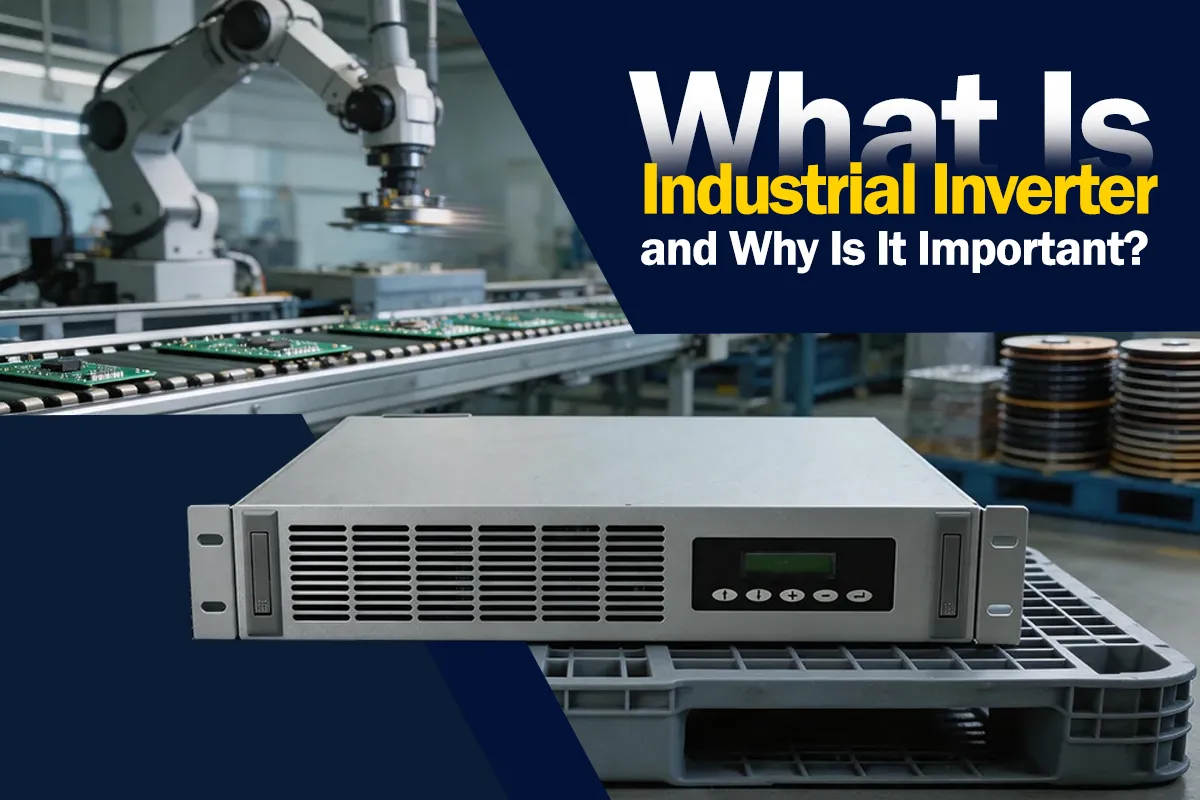
What Is an Industrial Inverter and Why Is It Important?
Industrial inverters are important components in modern electrical and automation systems. They help control the operation of electric motors by regulating electrical power and adjusting motor speed according to the requirements of the machine. In factories where motors operate continuously, the right inverter can improve process control, energy efficiency, and equipment reliability.
What Is an Industrial Inverter?
An industrial inverter, often referred to as a Variable Frequency Drive (VFD) when used for motor speed control, is an electronic device that controls the frequency and voltage supplied to an electric motor.
By adjusting these electrical parameters, the inverter can control motor speed and torque rather than simply operating the motor at a fixed speed.
Industrial inverters are commonly used with conveyors, pumps, fans, compressors, mixers, production machines, and other motor-driven equipment.
How Does an Industrial Inverter Work?
An inverter receives electrical power and converts it into a controlled output suitable for the connected motor. The controller can then adjust the motor’s operating speed based on the requirements of the production process.
For example, a conveyor may need to operate at different speeds depending on production conditions. Instead of running the motor continuously at full speed, the inverter can adjust its output to provide the required operating speed.
This level of control can also reduce unnecessary mechanical and electrical stress on the motor.
Why Are Industrial Inverters Important?
The reasons include:
1. Precise Motor Speed Control
One of the primary functions of an industrial inverter is to regulate motor speed. This allows manufacturers to match machine operation with actual production requirements.
Precise speed control is particularly useful for conveyors, pumps, fans, mixers, and automated production equipment where operating speed directly affects productivity and product quality.
2. Improved Energy Efficiency
Motors do not always need to operate at their maximum speed. An inverter can reduce motor speed when full output is unnecessary.
This can be particularly valuable in applications such as pumps and fans, where reducing speed can significantly reduce energy consumption. Lower energy use can help factories control operating costs while maintaining the required production performance.
3. Smooth Motor Starting
Starting a motor directly at full power can create a high starting current and mechanical stress. An inverter can provide a controlled acceleration process, allowing the motor to reach its operating speed more gradually.
Smooth starting can reduce stress on motors, couplings, belts, gearboxes, and other connected mechanical components.
4. Better Process Control
Industrial production processes often require precise control over motor speed. An inverter allows operators and automation systems to adjust motor operation according to changing production conditions.
This can improve consistency in processes such as material handling, mixing, pumping, winding, and automated manufacturing.
5. Motor Protection
Many industrial inverters provide monitoring and protection functions that can help identify conditions such as overload, overcurrent, overheating, or other abnormal operating conditions.
These features can help protect the motor and connected equipment from certain operating problems and provide useful information for maintenance teams.
Common Industrial Applications
Industrial inverters are used across many manufacturing environments. Typical applications include:
- Conveyors
- Pumps
- Industrial fans
- Compressors
- Mixers
- Extruders
- Packaging machines
- Material-handling systems
- Production lines
- HVAC equipment
The inverter must be selected according to the motor and application rather than simply based on motor power.
Read More: How to Choose the Right Hydraulic Motor for Your Application
What Should You Consider When Choosing an Industrial Inverter?
Selecting the correct inverter requires consideration of several technical factors.
Motor Specifications
The motor’s voltage, current, power, frequency, and operating characteristics should be compatible with the inverter. The motor’s rated current is particularly important when selecting an appropriate drive.
Application Requirements
A simple conveyor may have different inverter requirements than a high-performance machine requiring precise torque and speed control. The application should therefore be evaluated before selecting the drive.
Operating Environment
Temperature, dust, humidity, vibration, and other environmental conditions can affect inverter performance. For demanding industrial environments, the inverter should have appropriate protection and cooling arrangements.
Control Requirements
Some applications require basic speed control, while others need advanced features such as closed-loop control, precise torque management, communication with PLCs, or integration with industrial networks.
Spare Parts Availability
For critical production equipment, availability should also be considered when choosing an inverter. If a specific model is difficult to source, an unexpected failure could result in extended downtime.
Maintaining a compatible replacement inverter or critical inverter components can help maintenance teams restore equipment more quickly.
Read More: Industrial Spare Parts Buying Guide for Maintenance Managers
Signs an Industrial Inverter May Need Attention
An inverter may require inspection when a motor begins experiencing unexpected speed changes, repeated trips, overheating, unusual alarms, or difficulty starting.
However, an inverter fault does not always mean that the inverter itself has failed. Problems with the motor, wiring, power supply, load, cooling system, or connected equipment can also trigger inverter alarms. Proper troubleshooting should therefore identify the underlying cause before replacing the drive.
Conclusion
Industrial inverters provide controlled and efficient operation of electric motors across a wide range of manufacturing applications. By regulating motor speed, improving starting performance, supporting process control, reducing unnecessary energy consumption, and providing protective functions, they can contribute significantly to reliable industrial operations. Selecting the correct inverter and maintaining suitable spare parts can also help minimize unexpected downtime.
Industrial Inverters and Automation Spare Parts from SAEN
SAEN supplies industrial automation, electrical, and motor-control components for manufacturing applications. If you need an industrial inverter, replacement drive, or other automation spare parts, contact SAEN to discuss your equipment requirements and find a suitable solution for your application.
Leave a Reply
No comments have been sent yet!