
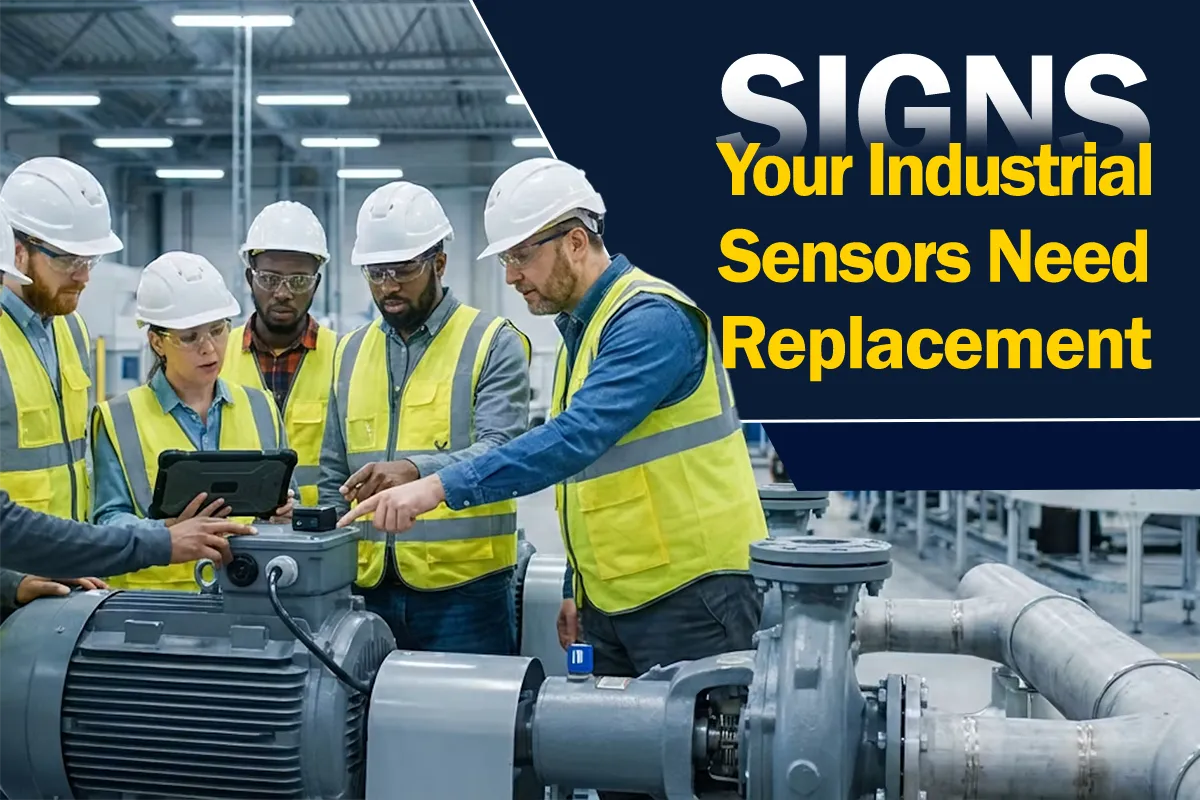
Signs Your Industrial Sensors Need Replacement
Industrial sensors play a critical role in monitoring temperature, pressure, position, speed, flow, proximity, and other operating conditions. When a sensor begins to fail, the problem may initially appear as an equipment or automation issue. Recognizing the warning signs early can help maintenance teams prevent inaccurate measurements, production interruptions, and unexpected downtime.
1. Inconsistent or Unstable Readings
One of the most common signs of sensor deterioration is fluctuating or inconsistent output under stable operating conditions. If a temperature, pressure, proximity, or position sensor suddenly produces readings that do not match the actual process, the sensor may be damaged, contaminated, or reaching the end of its service life.
Before replacing it, technicians should check wiring, connectors, power supply, and the control system to make sure the problem is not caused by another component.
2. Frequent False Signals
A failing sensor may send signals even when the monitored condition has not changed. For example, a proximity sensor might repeatedly indicate that an object is present when the machine is empty, or a pressure sensor may report unexpected pressure changes.
These false signals can cause unnecessary machine stops, incorrect automation responses, or defective products.
Read More: How to Reduce Downtime in Ceramic Manufacturing Through Proper Spare Parts Management
3. Slow Response Time
Industrial sensors are expected to respond quickly when operating conditions change. A noticeable delay between a physical change and the sensor’s output can indicate deterioration.
Slow response is particularly important in automated production lines where sensors control timing, positioning, safety functions, or process parameters.
4. Increased Production Errors
Sensor problems do not always appear as obvious sensor faults. Sometimes their first indication is a decline in product quality. Incorrect temperature, pressure, position, or speed measurements can cause machinery to operate outside its intended parameters.
If production defects increase without an obvious mechanical cause, sensors and their signals should be included in the troubleshooting process.
5. Unexpected Machine Stops
Sensors are often connected directly to PLCs and control systems. When a sensor produces an incorrect signal, the control system may interpret it as a fault condition and stop the machine.
Repeated unexplained shutdowns should therefore be investigated rather than simply resetting the equipment each time.
6. Visible Physical Damage
Physical inspection can also reveal when a sensor needs replacement. Cracks, corrosion, damaged cables, loose connections, overheating, contamination, or deformation can affect sensor performance.
Industrial environments such as ceramic factories, manufacturing plants, and automated production lines can expose sensors to dust, vibration, heat, moisture, and chemicals, accelerating wear.
7. Communication or Signal Problems
Modern industrial sensors may communicate with PLCs, controllers, drives, and other automation equipment. Intermittent communication, signal loss, abnormal output values, or repeated diagnostic alarms can indicate a sensor or connection problem.
However, technicians should check the complete signal path—including cables, connectors, power supplies, and control modules—before replacing the sensor.
When Should an Industrial Sensor Be Replaced?
Sensor replacement should be considered when troubleshooting confirms that the sensor itself is responsible for inaccurate or unstable signals, particularly when repair is impractical or the component has reached the expected end of its service life.
For critical equipment, maintenance teams should also keep suitable replacement sensors in stock. Having the correct spare available can significantly reduce downtime when a failure occurs. Contact SAEN for further information.
Conclusion
Inconsistent readings, false signals, slow response, production errors, unexpected machine stops, physical damage, and communication problems are among the most important signs that an industrial sensor may need replacement. Regular inspection and timely replacement of critical sensors can improve automation reliability, reduce downtime, and help maintain consistent production performance.
Leave a Reply
No comments have been sent yet!